What Sound Healing Did to My Body (And What Science Says)
I don't talk about this much.
For the past year and a half, I've been navigating some serious health challenges, the kind that rewrite your priorities, test your faith, and force you to look at your life with a completely different lens. This is still a tender chapter, and I'm sharing it gently. But what I will tell you is this: it's been one of the hardest seasons of my life, and sound has been one of my greatest sources of healing through it.
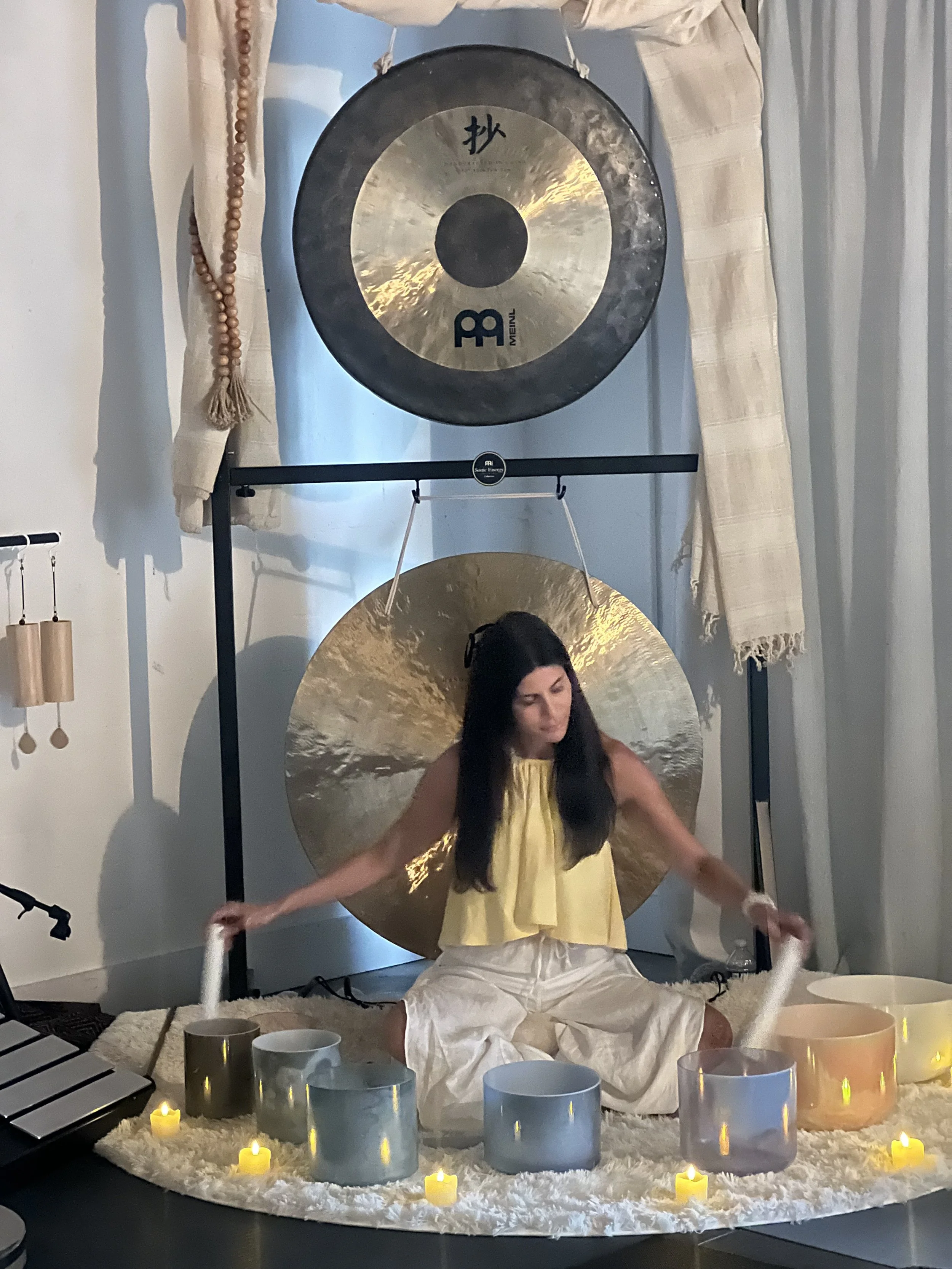
I know how that might sound to someone who's never experienced it. Trust me, I understand the skepticism. But I'm also someone who has been immersed in sound every single day through this journey. I've played my bowls in the morning when I was scared. I've sat in the frequency when I didn't have words. I've let vibration do what my mind couldn't.
And I've watched my body respond.
What follows is my honest experience, and the science that helped me understand why it works.

When Your Body Becomes the Battle
There's something deeply disorienting about facing a health crisis when your work is rooted in healing others. You find yourself simultaneously the practitioner and the patient. You know the tools. You believe in them. But when it's your body, when it's your life on the line, everything becomes more personal, more urgent, and more tender than you could have prepared for.
I kept showing up. To my bowls. To my practice. To my sessions with clients. Not because I had to, but because I needed to. Being in the presence of sound, both playing it and receiving it, became the one constant that helped me feel like myself again on the days when I barely recognized the person in the mirror.
I'm not saying sound healing replaced my medical treatment. It absolutely did not. But it sat beside it, faithfully, every single day, and I believe with my whole heart that it supported my body's ability to heal.
Now I want to show you why I believe that, backed by the research.
What Sound Actually Does to Your Body
Most people think of sound healing as relaxing. And yes, it is. But calling it "relaxing" is like saying surgery is "just a nap." The physiological events happening beneath the surface during a sound bath are far more significant than most people realize.
It shifts your nervous system out of survival mode.
When we're facing a health crisis, or really any sustained stress, our body locks into what's called the sympathetic nervous system response. Fight or flight. Cortisol floods the body. Heart rate elevates. Digestion slows. Cellular repair takes a back seat to immediate survival.
Sound changes that.
Research published in peer-reviewed journals has shown that low-frequency sound interventions, including singing bowls, increase parasympathetic nervous system activity, slowing heart rate, lowering blood pressure, and moving the body into what scientists call "rest and repair" mode.
This isn't metaphorical. It's measurable. It's the difference between a body at war with itself and a body remembering how to heal.
It lowers cortisol, the hormone that blocks healing.
Cortisol is often called the stress hormone, and in short bursts, it's useful. But sustained high cortisol, the kind that comes with months of health challenges, fear, and uncertainty, actively suppresses immune function and impairs the body's ability to repair itself.
A 2016 study found that just 20 minutes of singing bowl meditation produced significantly lower cortisol levels in participants. A 2025 review published in Frontiers in Immunology confirmed this, noting that sound and music therapy lowers cortisol and increases oxytocin, which helps with bonding, pain relief, and emotional comfort.
I played my bowls every single morning during my hardest months. I didn't know then exactly what was happening in my body. But my nervous system knew. It responded every time.
It activates the immune system at a cellular level.
This is the part that genuinely moved me when I read the research.
A 2025 review in Frontiers in Immunology found that music and sound therapy increases natural killer cell activity, the immune cells that are among the body's primary defenders against disease. It also increases immunoglobulin A, an antibody that plays a critical role in immune defense.
Meanwhile, a study out of Kyoto University found that audible sound waves applied to cells activated nearly 190 genes, many of them tied to inflammation regulation and cellular repair.
Read that again. Sound activates healing at the genetic level.
I am not a scientist. But I am a woman who was fighting for her health and found herself drawn to her sound bowls every single day, and now I understand a little better why my body was asking for it.
It reduces inflammation.
Chronic illness and the treatment that often accompanies it can drive significant inflammation in the body. Sound therapy has been shown to reduce inflammatory markers including IL-6, a key driver of systemic inflammation, particularly in medical settings.
The Association of Accredited Naturopathic Medical Colleges noted in 2026 that low-frequency sound interventions can increase parasympathetic activity and reduce physiological stress markers, including improvements in heart rate variability and reduced cortisol levels.
Less inflammation. More space for the body to heal.
It supports your brain, even when fear is running the show.
One of the quieter losses of a health crisis is what it does to your mind. The fear. The intrusive thoughts at 3am. The way your brain loops on the worst-case scenario until you can barely find your breath.
Research from MIT has shown that 40 Hz sound stimulation, a frequency used in sound therapy, activates gamma brain waves, reduces neuroinflammation, and supports cognitive processing and neural clarity.
Sound helped me get out of my head. Literally. And science explains why.

What I Know Now That I Didn't Know Before
I became a Certified Sound Practitioner because I believed in sound. I had seen it work for hundreds of people, helping them release grief, quiet anxiety, sleep deeply, feel something shift.
But I didn't fully understand what it was doing inside the body until I needed it for myself.
Here's what I know now.
Sound is not a substitute for medical care. Please hear that clearly. If you are facing a health challenge, get the medical support you need. See your doctors. Follow your treatment plan.
But sound can be the thing that sits beside all of it. It can lower the cortisol your treatment is elevating. It can support the immune response your body is working so hard to maintain. It can bring your nervous system back from the edge of panic so your body has the resources to repair.
It can be the thing that reminds you, on the hardest days, that your body is fighting for you.
That's what it was for me. That's what I believe it can be for you.
Sound Healing Is Now Used in Hospitals and Cancer Centers
I want to name this because it matters: sound healing is no longer on the fringes of medicine.
The International Society of Integrative Oncology now recommends music and sound therapy to manage health-related psychological distress. Cancer centers offer sound sessions to reduce stress during treatment. Hospitals use sound therapy as part of post-operative care. A 2024 systematic review identified 19 clinical studies from 8 countries confirming singing bowl therapy's effects on anxiety, depression, mood, blood pressure, and quality of life.
This is not wishful thinking. This is evidence. And it's growing.
To Anyone Walking a Hard Road Right Now
If you are in the middle of something hard, a diagnosis, a treatment, a season of uncertainty that has turned your life upside down, I see you.
I've been in the room with my own fear. I've sat with the unknown. I've had days when getting up felt impossible and the only thing that helped was the sound of my bowls filling the space around me.
I'm not here to tell you sound will fix everything. I'm here to tell you that it helped me, and the science tells us it's not just in our heads.
Your body is working for you. Give it every possible resource to do that work.
Sound is one of them.
Teresa Williams is a Certified Sound Practitioner, Intuitive Medium, and the founder of Inspire Teresa, based in Tampa, FL. She offers sound healing sessions, mediumship readings, and private events both in person and via Zoom.
Sound healing is a complementary wellness practice and is not intended to diagnose, treat, cure, or replace medical care. Always consult your healthcare provider regarding your health.
-
Association of Accredited Naturopathic Medical Colleges. "The Science of Sound Therapy: Vibrational Medicine in Clinical Practice." February 2026. aanmc.org/naturopathic-medicine/science-behind-sound-therapy
Pesek A, Bratina T. "Gong and Its Therapeutic Meaning." Musicological Annual. 2016;52(2):137-161.
Fu Y, Wu K, Zhuang J, et al. "Music therapy in modulating immune responses and enhancing cancer treatment outcomes." Frontiers in Immunology. 2025;16. doi: 10.3389/fimmu.2025.1639047
Kumeta M, Otani M, Toyoda M, Yoshimura SH. "Acoustic modulation of mechanosensitive genes and adipocyte differentiation." Communications Biology. 2025;8(1). doi: 10.1038/s42003-025-07969-1
MIT Picower Institute. "Evidence that 40 Hz gamma stimulation promotes brain health." March 2025. news.mit.edu/2025/evidence-40hz-gamma-stimulation-promotes-brain-health-expanding-0314
Zeng Y, et al. "Therapeutic effects of singing bowls: A systematic review of clinical studies." PMC. 2025. pmc.ncbi.nlm.nih.gov/articles/PMC12063014